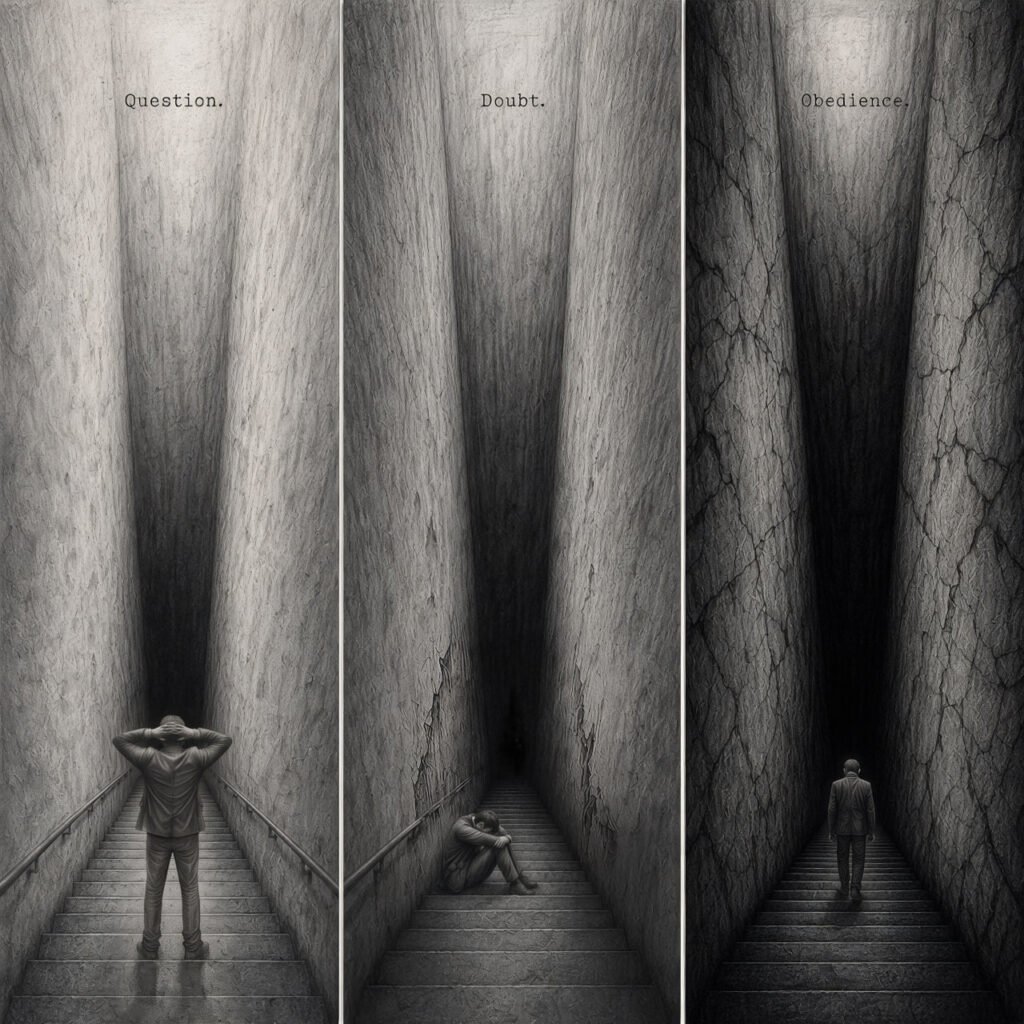
There are questions that ask for information.
What time does the train leave?
How far is the nearest town?
What happens if we take the other road?
An answer arrives, and the question disappears. It has completed its function. The world contains something unknown, then something known, and life continues with one uncertainty less.
But not every question is built to disappear so easily.
Some questions are asked because something in a person no longer agrees with the life around him.
Why did this happen?
Why did I allow it?
Why do I become smaller precisely when I most need to remain myself?
These questions do not ask only for facts. They ask whether the world is still coherent, whether another person can be trusted, and whether the one asking still has the right to believe his own perception.
A question of this kind is not merely a sentence.
It is a movement.
Something inside reaches outward.
A child does this without hesitation. The world is not yet divided into questions that are permitted and questions that should remain hidden. Curiosity travels directly from the child toward whatever surrounds him. He asks because he assumes that an answer may exist and that someone may be willing to meet him there.
The answer matters.
But so does the reception of the question.
A parent may not know. A teacher may be distracted. A partner may be exhausted. A friend may misunderstand what is really being asked. No human being can respond correctly to every opening offered by another person.
Still, each response carries more than its visible content.
It can tell the questioner that his confusion deserves attention. That his fear has entered a shared reality. That his perception may be incomplete without being absurd. That not knowing is a condition two people can stand inside together.
Or the response may be little more than not now, this is not important, you are too sensitive, or simply the silence of someone who has already turned toward something else.
Often there is no intention to harm. People fail one another through pressure, fatigue, habit and the inability to recognize the scale of what is happening inside someone nearby.
Intent does not control consequence.
A sentence spoken while looking away may remain in another person long after the speaker has forgotten it. A question dismissed as trivial may have been the first attempt to name something that will organize an entire life. An answer offered casually may become permission. An absence of answer may become instruction.
No one can know in advance which moment will carry this weight.
That uncertainty makes both accusation and absolution inadequate.
Parents shape children while carrying the shapes left in them by their own parents. Partners enter intimacy with fears learned before they met. Families develop habits that no single member designed. A person can wound another while trying to protect him or fail to see a signal while surviving a crisis of his own.
This does not make the effect unreal. It means only that causation is wider than intention, and responsibility is more complicated than guilt.
The more important question is what happens next.
What happens when an opening toward the world repeatedly finds no place to land?
At first, the question returns unchanged. Then something begins to attach itself to it. The person no longer asks only why this is happening. He begins to ask why no one else sees it, whether he is wrong to be affected by it, and finally whether the problem may be the one who sees it at all.
The direction has reversed.
The question that once reached outward now begins to work on the person who asked it. Its subject changes. The world is no longer the only thing under examination. The reliability, courage and legitimacy of the self enter the trial.
This reversal may happen in childhood. It may happen much later. The same question asked at twenty is not the same question at forty. Experience changes its weight. Betrayal changes its vocabulary. Exhaustion changes the number of answers a person is still capable of imagining.
Timing is part of meaning.
A question that might once have opened a path can arrive after years of pressure and find that the inner ground required to carry it has already weakened.
The transformation does not require a visible catastrophe. A person may continue to work, speak, make decisions and fulfil obligations. From the outside, nothing essential appears to have changed.
Inside, change proceeds through choices too small to look decisive.
He does not defend a position he believes in because this is not the right moment. He accepts a version of events he knows is incomplete because resistance would cost too much. He remains silent to preserve a relationship, a role or simply the energy required to survive the rest of the day.
Each concession can be explained.
That is what makes accumulation possible.
There may be fear in this. There may be cowardice. There may also be adaptation and an accurate recognition that every act of integrity has a price. The point is not to decide which word condemns the person correctly. The point is that, whatever the reason, the part of him that objected is repeatedly asked to withdraw.
He does not necessarily choose against himself in one dramatic moment.
He postpones himself.
Again and again, the immediate difficulty is avoided and the necessary confrontation is delayed. The self is told that it will be allowed to speak later, under safer conditions, when more strength is available.
Later becomes a method of silence.
The large self capable of occupying space, making a claim and accepting the consequences begins to contract. Not because it has been disproved, but because it has been exercised less often. What was once an I becomes an i: still present, still alive, but increasingly unable to determine the direction of the person carrying it.
This is not yet obedience.
There is still conflict. There is still someone inside who notices the betrayal. There is still a question.
And a question, however painful, preserves an important freedom. It admits that reality exists beyond the question itself. It assumes that new information might matter. It leaves room for another interpretation, another action, another future.
A question says: I do not know.
The words can contain terror, but they also contain space.
Doubt begins to change the nature of that space.
Not every doubt is destructive. Doubt can interrupt arrogance, expose error and prevent a person from mistaking desire for truth. It can force a belief to earn its authority. A doubt confronted and survived may strengthen the self that examined it.
But doubt can also cease to be an instrument.
It can become an environment.
At first, the person still believes he is investigating something. He returns to memories, tests explanations, asks other people and tries to separate fear from evidence. Yet every attempt to establish certainty generates a new reason why certainty cannot be trusted.
Silence confirms the fear because no one has denied it. Contradiction confirms it because resistance was expected. Support becomes suspicious because it may be motivated by pity. A moment of relief is treated as a dangerous loss of vigilance.
The doubt does not need to reject new information. It accepts everything and changes its meaning.
This is what makes severe doubt fundamentally different from a difficult question.
A question can be answered.
Doubt learns to survive the answer.
It begins by challenging a conclusion, then attacks the instruments by which any conclusion could be reached. Memory becomes unreliable. Perception becomes suspect. Emotion is dismissed as distortion. Reasoning is accused of serving desire.
The person is asked to investigate his own reality using tools that the investigation has already declared untrustworthy.
He does not simply doubt what happened.
He doubts his ability to know what happened. He doubts the memory, then the mind that holds it, then the judgment that decides whether that mind can be trusted.
The loop tightens.
Doubt turns back upon the faculty examining it. The observer becomes another object of suspicion. Even the attempt to question the doubt is absorbed as one more reason to continue doubting.
At this point, an answer no longer closes the original question. It produces another layer of doubt around the answer. Reassurance requires verification; verification requires trust; trust becomes the very thing that can no longer be granted.
The process closes around itself.
A change in circumstance is dismissed as temporary. A new relationship is measured according to an old injury. A danger that has disappeared continues to govern behaviour because the internal world created around it remains intact.
External reality may change once.
It may change ten times.
The internal model no longer updates.
This does not happen because the person consciously prefers illusion. The model may have developed to protect him. It may have reduced uncertainty at a moment when uncertainty was unbearable. It may have converted a chaotic experience into rules, and rules can feel safer than openness even when the rules are cruel.
If closeness led to betrayal, distance begins to feel intelligent. If speaking led to humiliation, silence begins to feel disciplined. If resistance repeatedly failed, surrender begins to look like realism.
The mind is not always trying to make a person free.
Sometimes it is trying to make pain predictable.
Predictable pain can be organized. It can be anticipated, rehearsed and incorporated into identity. Hope is more dangerous. Hope requires exposure to an outcome the person can no longer control.
So doubt accumulates structure.
What began as uncertainty becomes a method of interpreting every event. What began as a response to one wound becomes a theory of relationships. What began as caution becomes character.
The person no longer carries doubt into the world.
He carries the world into doubt.
And yet doubt has not fully triumphed.
As long as the person remains divided, something in him still refuses. Pain is evidence of conflict. Fear is evidence that another future can still be imagined. Even despair may contain a comparison between the world that exists and one that should have been possible.
The final transformation begins when that comparison disappears.
By this stage, there may be no questions left in the area where the first question was asked. There may not even be doubt. One interpretation has absorbed every alternative and now presents itself as fact.
Doubt triumphs by abolishing the experience of doubt.
It wins when the person becomes certain that he cannot know, cannot change, cannot trust, cannot resist or cannot become anything beyond the shape already assigned to him.
The distorted reality no longer feels distorted.
It simply feels real.
This is Obedience.
Not obedience to a government, an institution or a visible authority. The source of control is internal. It speaks in the person’s own voice. It uses his own experience as evidence.
No external force needs to maintain it.
The person will do that himself.
He withdraws before rejection. He abandons a conviction before anyone demands it. He chooses the familiar defeat before events can expose him to another possibility. He calls this realism because the word surrender would require him to remember that a choice once existed.
New evidence now arrives too late. It is dismissed before it can become experience. A changed circumstance is forced to serve an unchanged conclusion. The world is permitted to move only inside the limits already established by doubt.
The person is no longer asking whether the belief is true.
The belief decides what he is capable of recognizing as truth.
He may be surrounded by people and remain unreachable. Their words reach him, but not intact. Each one is translated by the same system before it can become evidence.
He is not isolated by distance.
He is isolated by interpretation.
From the outside, the exit may appear close. One conversation could expose the error. One refusal could interrupt the pattern. One small act could prove that the forbidden movement is physically possible.
But distance is not measured only in metres or effort.
A movement can be small and still remain psychologically unavailable. The person may possess enough strength to act while no longer possessing the inner permission to believe that action can lead anywhere.
He gives up before movement begins.
Not because nothing can be done.
Because his reality contains no credible image of what doing something would mean.
There can be relief in this.
Not warmth. Not safety. The relief of no longer having to choose.
Conflict is exhausting. A question demands attention. Doubt generates endless alternatives. Obedience closes them.
The pressure does not disappear. It becomes order.
Surrender can feel almost merciful. There is no longer a need to examine every possibility, defend every perception or wait for permission to trust oneself. The mind grows quieter because the voice that resisted has been denied the right to speak.
For a moment, the absence of freedom feels like the absence of fear.
This is the seduction. What disappears first feels like pain. What has actually disappeared is the part capable of refusing it.
Nothing outside needs to break.
He pours coffee. He answers an email. He listens while someone he loves speaks. He remains competent, useful and present enough to escape concern.
No one witnesses the transfer of authority. There is no scene that another person can point to later and name as the moment of collapse.
The catastrophe is complete enough to govern a life and quiet enough to pass for an ordinary day.
This can look like peace.
It can look like maturity, discipline or acceptance. The person appears calmer because the part of him that argued has become quiet. He is easier to predict, less likely to resist, less likely to demand that reality be examined again.
The absence of resistance can be mistaken for the absence of harm.
But calm is not freedom.
The inner conflict has not been resolved. One side has been removed from the negotiation.
The mechanism now has everything it needs: the person’s memory, his fear, his habits and his voice. It can anticipate opposition because it produces the opposition itself. It can defeat every attempt before the attempt becomes action.
This is why Obedience is more than exhaustion.
Exhaustion still remembers strength.
Obedience rewrites weakness as truth.
The person no longer says that he is afraid to act. He says there is nothing to do. He no longer admits that he has lost confidence in himself. He says this is simply how the world is.
The language has hardened.
Possibility becomes naivety. Resistance becomes self-deception. Hope becomes poor judgment. Surrender becomes the only position permitted to call itself rational.
There is no uncertainty left to examine, only instruction.
Do not trust.
Do not resist.
Do not begin.
Obey.
The command does not arrive from outside because the person already carries it into every decision he makes.
What began as a question has become a reality that cannot be questioned. Doubt no longer interrupts thought; it determines which thoughts are allowed to complete themselves. It no longer delays action; it decides which actions can be imagined. It no longer lives inside the person as one voice among others.
It has taken the position from which every other voice is judged.
Question.
Doubt.
Obedience.
The question reached outward because the person believed an answer could change him.
Doubt turned inward and changed the person instead.
Obedience completes the transformation. The person enforces the limitation, rejects the evidence and silences the remaining objection.
The final command is never heard as a command. It sounds like a conclusion the person reached by himself.
No captor has to finish the work.
He finishes it himself.
Doubt has no opponent left.
It has become the person who would have opposed it.
That is its triumph.