The Triumph of Doubt
Single — September 18, 2026
The Triumph of Doubt began with a psychological question:
What happens when doubt stops challenging reality and begins to replace it?
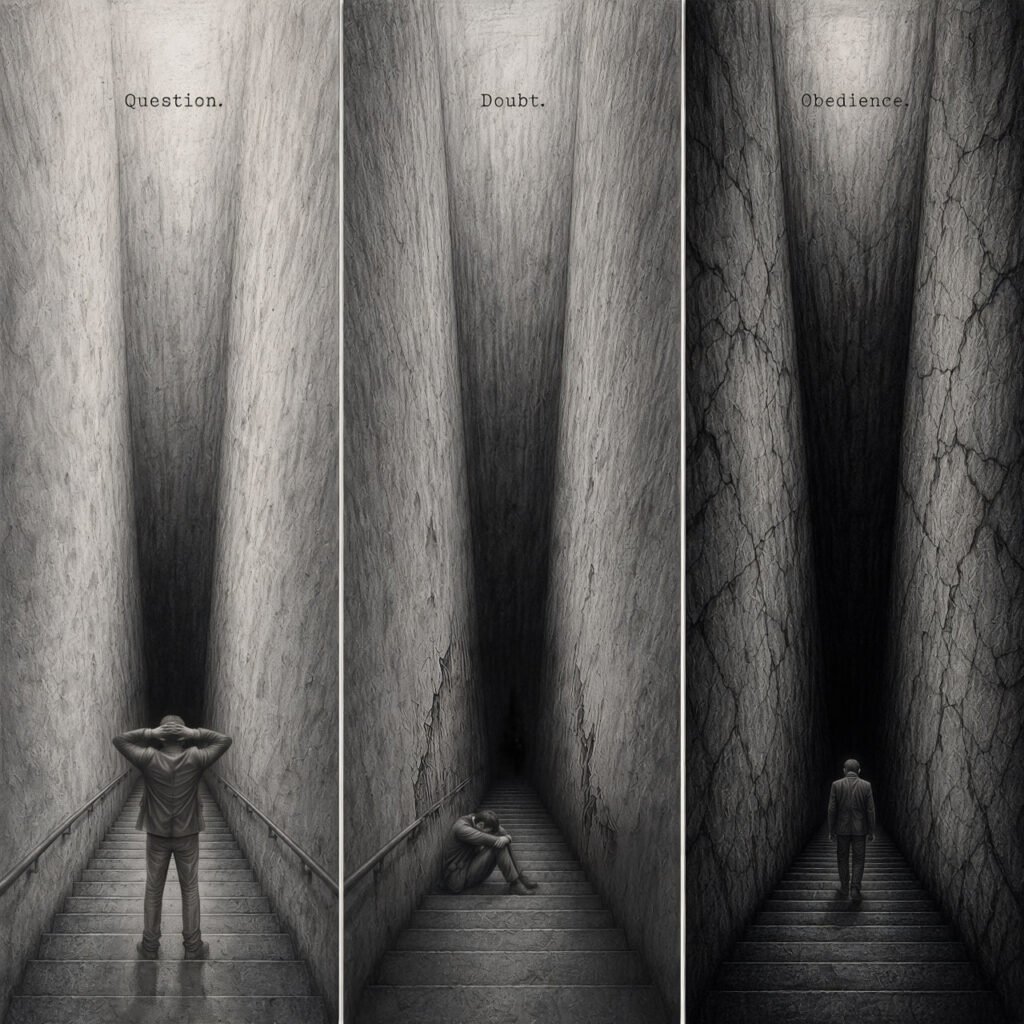
The work is built around three words — Question. Doubt. Obedience.
They describe not three separate scenes, but a continuous inner transformation. A question reaches outward because an answer may still change something. Doubt turns that movement inward, placing the person’s own perception and judgment under pressure. Obedience begins when the conflict is no longer experienced as conflict and its limitations are accepted as reality.
The musical form follows this progression through a broad change of scale. It begins in a chamber-like, personal space and gradually becomes denser, wider, and more physically intense. Rather than assigning a fixed meaning to every sound or section, this expanding arc carries the work from intimate uncertainty toward an overwhelming culmination.
The climax is not presented as a victory over fear or as the intervention of an external authority. It marks an internal transfer of power. Doubt no longer needs to argue because it has taken the position from which every answer is judged.
The Triumph of Doubt is about the point at which questioning loses its openness — when doubt ceases to be one voice within a person and becomes the voice that determines what can no longer be questioned.
Credits
Out September 18, 2026
Concept, music, and production by Aleksandr Shuvaev.
Live violins and violas performed by Rita Torrens.
Beyond the music
Continue The Triumph of Doubt through words
— available September 18.